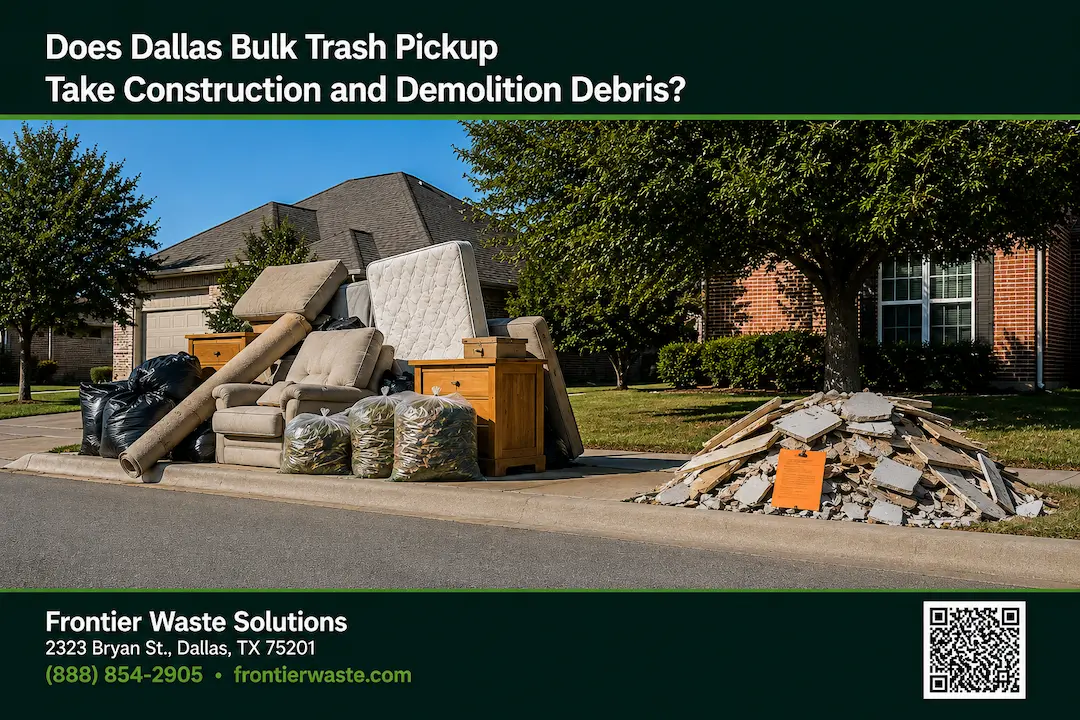
No. Dallas bulk trash pickup does not take construction and demolition debris, and that is one of the most consistent points of confusion for homeowners and contractors tackling a renovation. The City of Dallas curbside brush and bulky item program is built for household items too large for your rollcart, not for building materials generated by a contractor-driven project. If you are wondering whether that stack of drywall, roofing tear-off, or busted-up concrete can just go out to the curb with your old couch, the answer from the city itself is no, and setting it out anyway can trigger a fee and a citation.
What the City of Dallas Brush, Bulky, and Land Clearing Disposal Program Accepts
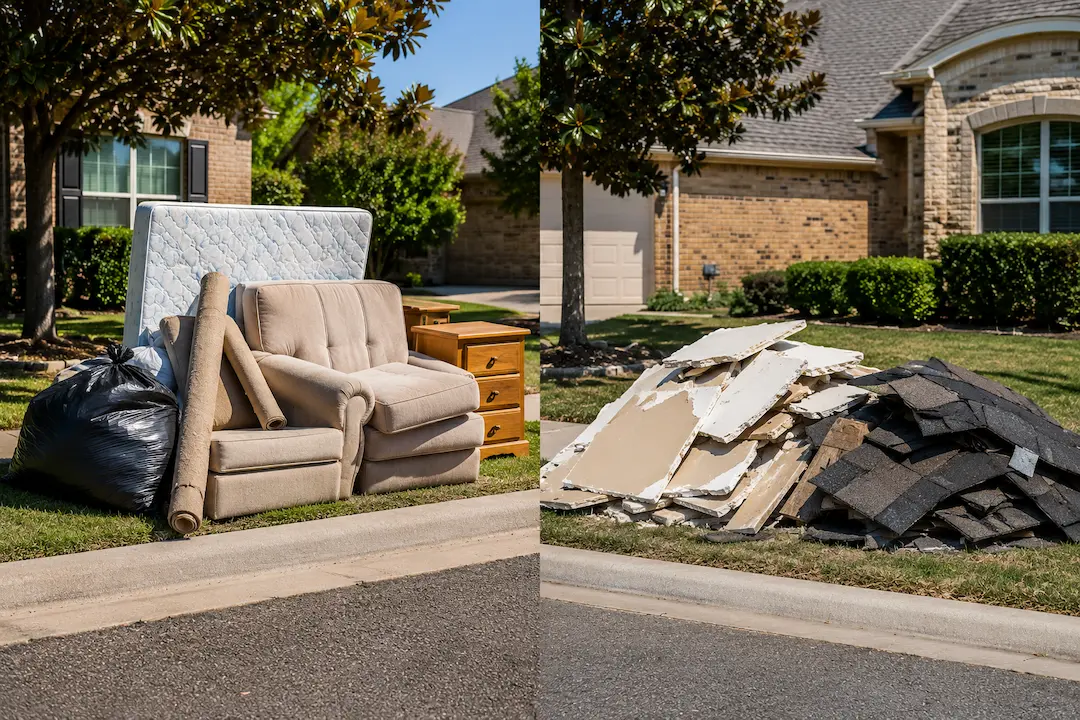
Dallas residential customers get monthly curbside brush and bulky item collection of up to 10 cubic yards, plus a once-annual exception to set out as much as 20 cubic yards if you request it through 311 the week before your scheduled pickup. This service is meant for household furniture, carpet, mattresses, toilets, bicycles, and large appliances like stoves, washers, and dryers (though anything holding coolant or gasoline, such as air conditioners, refrigerators, and lawnmowers, is excluded), and it exists specifically to handle household waste rather than construction byproducts. It also covers vegetative and land clearing waste: tree limbs and shrubbery, as long as individual pieces stay under 8 inches in diameter and 10 feet in length, plus bagged grass clippings and leaves.
Materials have to go out just behind the curb, between Thursday and Sunday of the week before your collection week, and they need at least 5 feet of clearance from roll carts, mailboxes, fences, water meters, utility poles, and parked cars. Placement matters more than most homeowners expect: crews use an automated grapple arm and claw to lift the pile directly into the truck, so anything wedged under low tree limbs, tucked behind a parked car, or pushed into the street will most likely get skipped rather than collected on a return trip. All of it is governed by Dallas City Code Section 18-4 and the city’s placement standards, and crews will skip anything their grapple truck cannot reasonably reach or safely lift without risking damage to nearby property.
It helps to think of the service in terms of what it was designed to solve: clearing out household items that are too big for your weekly rollcart, not clearing out a renovation. That distinction is the root of nearly every question people have about what does and does not qualify.
What Demolition Debris and Other Items Aren’t Accepted in Dallas Brush and Bulky Collection?
Beyond construction and demolition debris, the city’s not-accepted list rules out several categories that trip people up during a renovation or cleanout:
- No household garbage: trash in plastic bags that could otherwise fit in your rollcart.
- No commercial or business waste: the program is residential-only, regardless of property type.
- No construction or demolition debris: this includes demolition materials such as bricks, rock, asphalt, gravel, concrete, glass panes, doors, or mirrors, and anything with protruding nails.
- No automobile parts or tires.
- No dirt, soil, or sod.
- No electronics: computers, TVs, stereos, and microwaves.
- No roofing materials or shingles.
- No paints or chemicals.
Drywall falls under the construction and demolition category, so it is not accepted at the curb either, even in small quantities from a DIY patch job. Scrap lumber and cabinetry pieces fall into the same category and need the same handling. Nails, screws, and hardware left in scrap lumber or drywall pieces are a separate problem on top of that: the city specifically calls out items with protruding nails as unacceptable, since they present a hazard to the crew loading the truck by hand or with the grapple claw. The city is explicit that waste generated by a job requiring a contractor is the contractor’s responsibility to dispose of properly, not the curbside service’s. That rule applies whether the contractor is a licensed crew or a homeowner acting as their own general contractor on a weekend renovation.
Paint, chemicals, and anything with coolant or fuel residue get excluded for a different reason: they are regulated hazardous materials under Texas Commission on Environmental Quality regulations, not simply oversized junk. Old paint cans, solvents, pesticides, and similar household chemicals need to go through a dedicated household hazardous waste disposal channel rather than the curb, since mixing them into a standard collection truck creates a real safety issue for the crew and for whatever facility processes the load afterward. Sorting these materials at the point of generation, rather than mixing everything into one collection pile, is the single easiest way to keep hazardous waste out of the regular collection stream entirely. Most questions about handling waste properly in Dallas come down to this same principle: know your category, use the right path, and the rest tends to sort itself out.
Does Dallas Pick Up Construction and Demolition Waste?
No city-run curbside service in Dallas picks up construction or demolition debris, whether the work was done by a licensed contractor or a homeowner over a weekend. That rule exists for a practical reason: brush and bulky trucks use an automated grapple arm, and dense material like broken concrete, roofing shingles, or a torn-out bathroom vanity can damage the equipment or exceed what the crew can safely handle. So how do you throw away construction debris in Dallas? Your options are self-hauling it to a city disposal site, hiring a hauler that specializes in construction waste, or renting a roll-off dumpster sized for the job so everything gets picked up in one load once the project wraps. For a mid-size remodel, a construction dumpster rental built for contractors is usually the fastest way to keep debris off the ground and off the curb entirely. For a comprehensive construction and demolition teardown, the volume usually calls for a larger container from the start rather than upsizing partway through.
The self-haul route works for smaller loads if you have a truck or trailer and do not mind the trip, but it is worth weighing against your own time and fuel cost once you factor in a scale ticket at the disposal site. For anything beyond a single trunk load, a rented container tends to be the more efficient option, since it sits on site for the length of the job instead of forcing multiple runs back and forth as debris accumulates.
A good amount of construction and demolition material can be recycled rather than landfilled. Concrete and asphalt are commonly crushed on-site or at a regional facility into recycled aggregate for use as road base or fill, wood waste from framing and lumber can be chipped for mulch or biomass fuel, and scrap metal from fixtures or wiring has real resale value on its own. Some Dallas-area haulers fold construction and demolition recycling into a broader waste management approach, and separately, larger loads may call for professional debris management rather than a single container. Either way, working with a hauler who tracks diversion can meaningfully reduce what actually ends up at the landfill, so ask what percentage of a typical load gets sent to recycling before assuming everything goes straight to disposal.
Larger teardown jobs also come with their own paperwork. Tearing down or substantially altering a structure in Dallas typically requires a permit from the city before work starts, and a licensed demolition contractor usually handles that permit along with proper cleanup as part of the scope of work. Hazardous materials like asbestos or lead paint found during a teardown fall under separate EPA and state environmental rules and often need a specialized abatement contractor before regular demolition debris removal can even begin. For a straightforward interior renovation, the permitting bar is typically lower, but it is still worth checking with the city before assuming a job is exempt.
Construction waste breaks down into a handful of common streams on most residential jobs: drywall and gypsum, concrete and masonry, metals, roofing, and mixed general waste that does not sort cleanly into any other category. Sorting waste into separate piles as work happens, rather than mixing everything into one container, makes recycling and environmental compliance considerably easier down the line, and some haulers offer a discount on the hauling fee for loads that arrive pre-sorted. On a typical renovation, the biggest single waste stream by weight is usually concrete, drywall, or roofing material, not the lighter general waste people tend to picture first.
Dallas sits within a large regional network of landfills, transfer stations, and specialty recyclers, and which option makes sense often comes down to how the waste gets managed on-site. A hauler with strong local relationships can route concrete to an aggregate recycler, wood to a mulching operation, and metal to a scrap yard, while sending only the true mixed waste to a landfill. That kind of active management typically costs about the same as a single mixed-waste haul, since tipping fees are often lower at a recycling facility than at a standard landfill, and some haulers track diversion rates so a property owner can see how much of a job’s total waste never reached a landfill at all. Ask any hauler you’re considering how their management approach handles recycling before you sign a rental agreement, since local regulations around reporting diversion can vary by jurisdiction.
When comparing dumpster rental quotes for a construction or renovation cleanup, ask each hauler directly what happens to the waste after pickup. Some construction haulers landfill everything by default unless a customer specifically requests recycling, while others build recycling into every load automatically. That difference can affect both the environmental footprint of a job and, in some cases, the price, since recycling facilities sometimes charge less per ton than a standard landfill for clean, well-sorted waste. A transparent hauler should be able to tell you roughly what percentage of a typical construction load gets diverted from the waste stream into recycling, rather than giving a vague answer about being environmentally friendly in general.
Homeowners sometimes assume recycling costs extra, but in practice it often saves money rather than adding to the bill, since landfill tipping fees for mixed general waste tend to run higher than the fees at a dedicated recycling or aggregate facility. A hauler that separates loads by material, rather than treating every container as one undifferentiated waste stream, is usually able to pass some of that savings back to the customer. It is a fair question to ask upfront: does the quoted price already assume recycling where possible, or does recycling cost extra on top of standard hauling?
At the end of the day, whether you self-haul, hire a specialty hauler, or rent a container from Frontier, the goal is the same: get the waste off the property, keep as much as possible out of the landfill through recycling, and stay on the right side of the city’s rules along the way. Responsible waste handling is less about any single decision and more about picking a hauler who treats debris removal as a service, not an afterthought.
Is There a Fee for Non-Compliant Trash Set-Outs in Dallas?
Standard monthly bulk trash pickup is included in your city service, but setting out more than your limit, or setting out prohibited items like construction debris, generally does not mean it gets left behind. Dallas will usually still collect it and then automatically bill you for a non-compliant set-out at $60 per 5 cubic yards, charged in 5-cubic-yard increments. Early, oversize, and non-compliant set-outs can also draw a citation on top of that fee, and a flagged pile may get an orange tag identifying the violation that has to be corrected before the location gets serviced again. The fee structure exists to keep the curbside system fair for everyone: without it, there would be little incentive to stay within the posted limits, and the cost of extra pickups would just get absorbed into everyone’s rates instead of billed to the household that generated the excess waste.
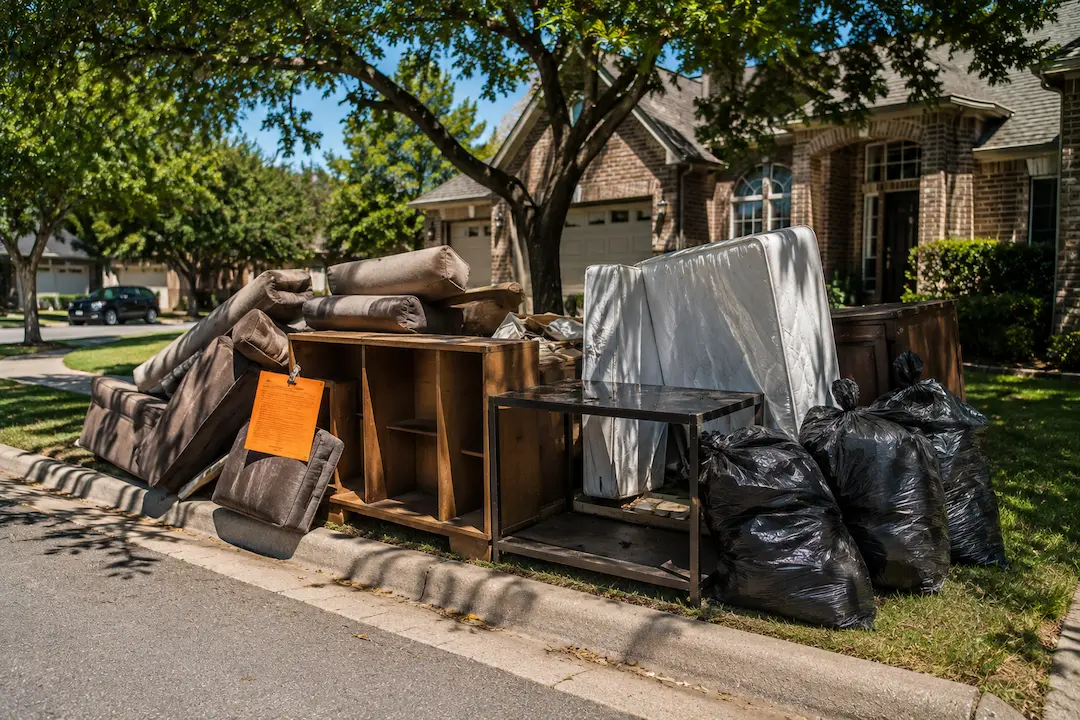
In other words, trying to sneak a small construction cleanup into your regular bulk week can end up costing more than just renting the right container in the first place. The fee schedule is also not a one-time penalty. Because it bills in 5-cubic-yard increments, a pile that runs several increments over the limit, or that mixes in several prohibited items, can rack up multiple charges on a single water bill, and repeated non-compliant set-outs at the same address tend to draw closer attention from code compliance going forward.
How Do I Set Out Large Items the Right Way in Dallas?
Confirm your collection week and set materials out between Thursday and Sunday beforehand, staying inside the 10 cubic yard limit (or requesting the 20 cubic yard exception through 311 in advance if you need it). Keep everything just behind the curb with the required clearance from obstructions, and separate out anything on the not-accepted list before it goes to the curb. If your pile includes construction debris, roofing material, paint, or electronics, those need a different path: a city disposal site for self-haul items, a household hazardous waste facility for chemicals and paint, or, for anything job-related, a rented container that can handle the volume and weight in one trip.
A useful gut check before setting anything out: ask whether the item came from a project that needed a permit, a contractor, or specialized tools to remove. If the answer is yes, it almost certainly falls outside curbside collection regardless of how it looks sitting at the curb next to a mattress or an old couch.
Can a Business or Rental Property Use This Program?
No. The city is explicit that brush and bulky item collection is not available for business or commercial properties, and that includes multi-unit rental properties operating as a commercial account. If you manage a business, office, or commercial rental in Dallas and need bulky items or general waste handled on a recurring basis, that falls under commercial trash pickup service rather than the residential curbside program. Landlords with a single-family rental billed as a residential account may still qualify for standard curbside service, but it is worth confirming the account type before assuming bulk pickup applies. Business waste and household waste are treated differently under the same city code, and management practices for a commercial account typically involve a dedicated dumpster rather than curbside limits.
The Better Option for Construction Debris and Wood Waste
For anything the city’s curbside service will not take, a roll-off dumpster is the practical substitute. Frontier’s Dallas dumpster rental service runs 20-yard, 30-yard, and 40-yard containers, which cover everything from a single-room renovation to a full teardown, and the container gets delivered, filled on your schedule, and hauled away in one trip instead of being sorted item by item at the curb.
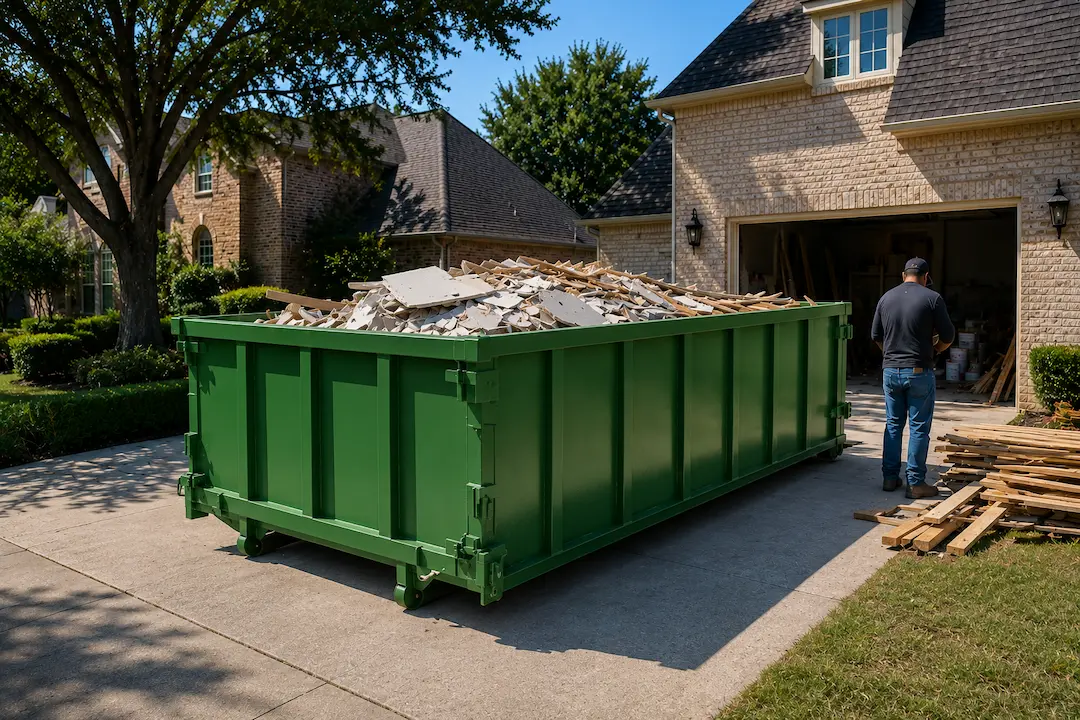
Before booking, it helps to know what a standard rental actually includes, since delivery, pickup, and disposal up to a weight allowance are typically bundled into the quoted price, with overage billed separately if the load runs heavy. It also helps to plan around how long a typical rental period lasts so the container is not sitting on site (and racking up per-day fees) longer than the project actually needs. Confirm the exact rental window and weight allowance for your container size when you get a quote, since both are matched to your specific job rather than fixed across every rental.
The waste construction crews generate on a renovation site, from drywall scraps to old fixtures, is exactly what these containers are built for, and choosing the right size upfront usually costs less than paying overage fees or ordering a second container partway through the work.
Frontier routes recyclable material out of every load where possible, so choosing a roll-off container does not mean abandoning the environmental benefits of proper waste handling, it just moves the sorting from the curb to the facility. For a job generating a genuinely large volume of mixed construction waste, that kind of behind-the-scenes recycling can matter more than which specific container size gets delivered. None of this needs to be complicated. Most households only deal with a single wave of household waste or renovation waste at a time, and matching the right service and the right amount of oversight to that one job is enough. Recycling more, tracking less waste overall, and keeping paperwork straight for anything requiring a permit will cover the vast majority of situations that come up.
Renovation and Cleanup Questions Dallas Homeowners Ask
- Can you throw away drywall in Dallas bulk trash?
- No. Drywall is a building material and falls under the construction and demolition debris category the city excludes from curbside pickup, regardless of the quantity.
- What about roofing materials or shingles?
- Roofing materials and shingles are also on the not-accepted list. A roofing tear-off needs to go through self-haul, a specialty hauler, or a rented container.
- Can I put dirt, soil, or sod in bulk trash?
- No. Dirt, soil, and sod are not accepted for curbside collection under any circumstance, including small amounts left over from landscaping work.
- Where can I dispose of paint or other chemicals?
- Paints and chemicals are excluded from curbside bulk trash entirely, since the city handles them as household hazardous waste rather than ordinary junk. Dallas directs residents to a dedicated household hazardous waste drop-off for these materials instead of the curb or a routine landfill trip.
- Can I self-haul electronics or debris to a city disposal site?
- Electronics are not accepted curbside, but Dallas residents can self-haul them, along with most other household waste, to McCommas Bluff Landfill or one of the city’s transfer stations at no charge in a passenger car, pickup, or trailer under 15 feet, with proof of Dallas residency. Uncovered loads carry a $40 fee, and construction debris terms are worth confirming with the site directly before hauling a large trailer.
Source: City of Dallas Sanitation Department, Brush & Bulky Item Collections (dallascityhall.com/departments/sanitation/pages/brush_and_bulky.aspx) and McCommas Bluff Landfill (dallascityhall.com/departments/sanitation/pages/mccommas_bluff.aspx), pulled 2026-08-06. Municipal fee schedules and program rules are subject to change; confirm current terms before relying on the figures above.
Need a Dumpster for Your Renovation? Frontier Waste Solutions
Now that you know what Dallas bulk trash pickup won’t take, the next step is renting the right container for your project. Tell us the size and scope of your job, and we’ll match you to a roll-off dumpster delivered on your schedule.
Request a Quote | (888) 854-2905
2323 Bryan St, Dallas, TX 75201
(888) 854-2905