
Most people rent a roll-off dumpster rental thinking about volume — how many cubic yards of debris will fit inside the box. That matters, but it is only half the story. Every roll-off also has a weight limit, and on a heavy job it is the weight, not the space, that runs out first. We see it all the time around Dallas: a homeowner fills a 20-yard container barely halfway with broken concrete from a patio tear-out and is already over the limit, while the same box could swallow an entire garage of light cardboard and furniture with room to spare. Understanding how weight limits work — and what your debris actually weighs — is the difference between a clean, predictable rental and a surprise charge on the final invoice. Here is how we explain it to customers.
What we can do is walk through what the weight limits actually are by container size, the real factors that determine whether your job is a volume problem or a weight problem, and the consequences worth understanding before anyone starts loading. That is the conversation we have with most customers when they call us about a Dallas roll-off — so here it is in plain terms.
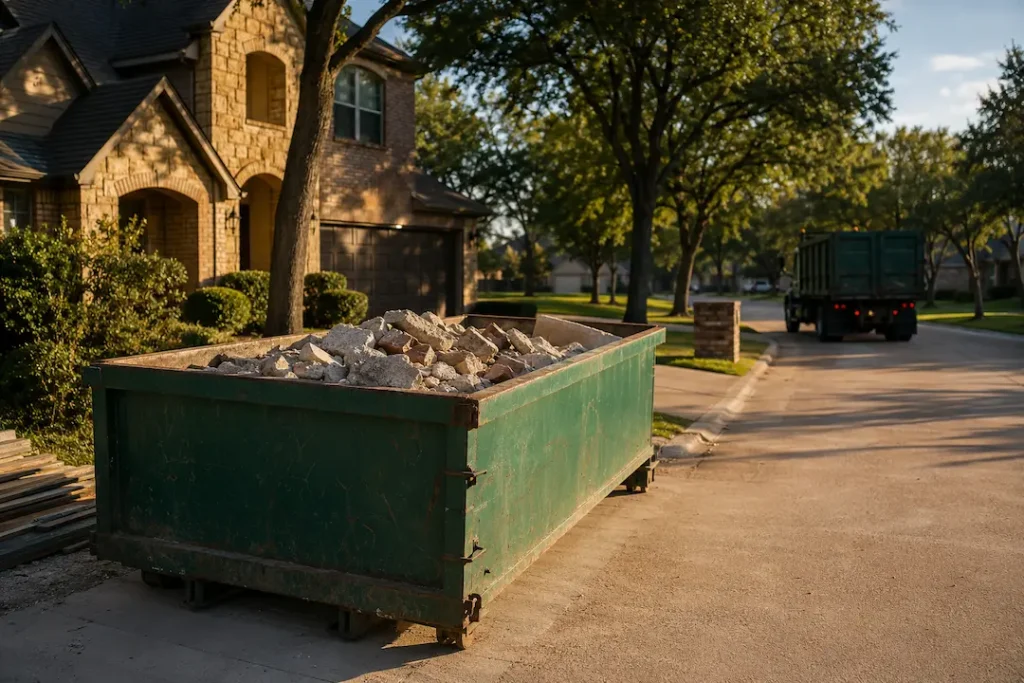
Before you dig in — related reading
If you want the bigger picture on sizing, pricing, and service before getting into weight limits, these pages cover the options behind everything discussed below:
- A side-by-side look at roll-off dumpster sizes and weight limits — match the box to the load before you book.
- How we handle roll-off dumpster rental across Dallas — delivery zones, placement tips, and what to expect.
- The details on renting a roll-off dumpster in Dallas, TX for home and job-site projects.
- Dedicated heavy-debris dumpsters for concrete crews — sized for dense material from the start.
- For steady business waste instead of a one-time haul, ongoing commercial trash pickup for businesses.
How Much Weight Can a Roll-Off Dumpster Carry?
Roll-off dumpsters are rated by tons, and the allowance climbs with the size of the box. A 10-yard container is built for the heaviest loads — dense debris fills its weight limit before it fills its space. Our 20-yard sits at 2–3 tons, the 30-yard at 3–5 tons, and our 40-yard at 5–6 tons. The real ceiling is what the loaded truck can legally haul on Texas roads. The container itself could physically hold more, but the weight limit on your rental reflects what can be picked up and transported safely. That is why two companies can quote different tonnage on the same size box — they are working from different truck capacities and rate cards.
How Much Weight Fits in a 10, 20, 30, or 40 Yard Dumpster?
Cubic yards measure how much space a container has; tons measure how heavy a load it can leave with. The two do not move together, which trips people up.
A 10-yard dumpster is built for dense, heavy debris precisely because it fills with weight before it fills with space — think a single room of tile or a small concrete slab. A 20-yard is the all-purpose choice for medium remodels and cleanouts, rated at 2–3 tons. A 30-yard suits whole-house cleanouts and larger renovations where the debris is bulky but lighter — 3–5 tons of allowance. A 40-yard is for high-volume, lightweight material like cardboard, light demolition debris, and commercial cleanouts, with 5–6 tons available, though that ceiling is rarely the constraint on a light load.
The key point: the bigger boxes are not meant to be filled to the brim with heavy material. Load a 40-yard with concrete and you will blow past the weight limit long before the box looks full. For a full breakdown of dimensions and tonnage specs by size, see our dumpster sizes and weight limits page.
Why Do Roll-Off Dumpsters Have Weight Limits at All?
The limit is not arbitrary, and it is not the rental company being stingy. A roll-off truck carrying a loaded container has to obey the same axle-weight and gross-vehicle-weight rules every other heavy truck on Texas roads follows. Overloaded trucks are harder to stop, harder on pavement, and unsafe on the highway — which is why those limits are enforced. The landfill or transfer station also weighs every load on a scale and charges by the ton, so the disposal cost is tied directly to weight. When a hauler sets a tonnage allowance on your dumpster, it is bundling a reasonable amount of that disposal cost into the rental and protecting the driver from rolling out overweight. Going over does not just cost more — an overloaded container may not be safe to lift at all, which can mean it has to be partially emptied before pickup.
What Happens If You Go Over the Weight Limit in Dallas?
The usual outcome is an overage charge: an extra fee for each ton — or part of a ton — above your included allowance, since we pay the landfill by the scale ticket. That is the single most common surprise on a dumpster invoice. In a more serious case, if a container is loaded so far past its limit that the truck cannot safely lift or transport it, the driver may not be able to take it as-is, and you could be asked to remove material before it can be hauled. None of this is meant to penalize you — it reflects real road-safety limits and real disposal costs. The way to avoid it is straightforward: be honest about what is going in the box up front so we can size it correctly and give you the included tonnage before you start loading. A clear number beats a surprise every time. For current Dallas delivery and service details, see how we handle Dallas roll-off containers.
What Are the Heaviest Materials to Watch Out For?
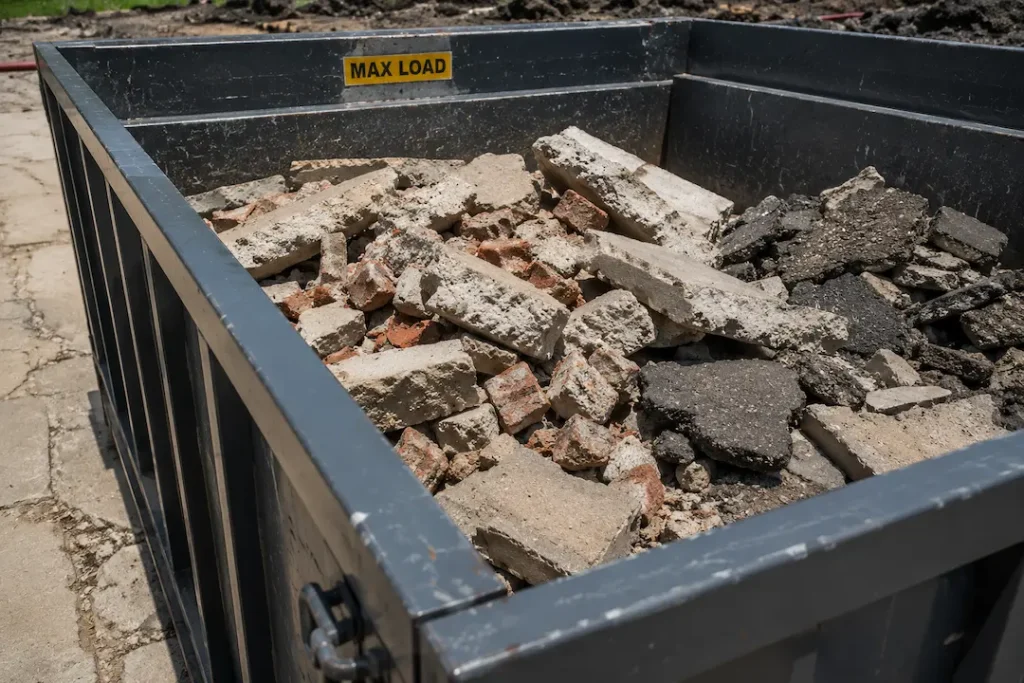
A few materials are dense enough that they should change how you think about size entirely. Concrete, brick, asphalt, dirt, gravel, and stone are the big ones — a small amount fills a weight limit fast, and we typically recommend a dedicated smaller container rather than mixing them into a large box. Our concrete dumpster rental service is sized specifically for these loads. Roofing shingles are another deceptive load: a single-layer tear-off on an average Dallas-area house can run several tons. Wet material adds hidden weight too — soaked carpet, soil, or yard waste after a North Texas rainstorm weighs significantly more than the same volume dry.
By contrast, household junk, furniture, cardboard, drywall, and light construction debris are bulky but relatively light, so you can fill a bigger box with them and stay well under the limit. The rule of thumb: the heavier and denser the debris, the smaller the box and the lower the fill line you should plan on.
How Do You Estimate the Weight Before You Fill the Box?
You do not need a degree in math, just a sense of what your debris is made of. Start by separating heavy material from light in your head: if the job is mostly concrete, dirt, brick, or shingles, plan around the weight limit and lean toward a smaller container. If it is mostly furniture, boxes, drywall, and general clutter, plan around the volume — a larger box is usually fine. For mixed projects, picture the heaviest single component and ask whether that alone could approach the tonnage allowance.
When the load is genuinely heavy, it is almost always cheaper to use a right-sized smaller container with the appropriate allowance than to overload a big one and pay overage. The easiest move of all is to describe the project to us before you book — square footage of a tear-off, how many slabs, roughly how deep the dirt — and we will translate that into the right size and a clear weight allowance so nothing on the invoice is a surprise.

Why the scale ticket, not the container, sets your bill
Every loaded roll-off in the Dallas area ends up on a landfill scale — for many local haulers that’s McCommas Bluff, the city’s landfill in southern Dallas — and disposal is billed by the ton off that scale ticket. That’s why roll-off pricing carries a weight allowance plus a charge for each ton (or part of a ton) over it. Dense debris like concrete, dirt, shingles, and wet material hits the cap fast, so heavy loads are about weight long before the box looks full.
Weight and overage questions, cleared up
Is the weight limit the same for every dumpster size?
No. Larger containers carry a higher tonnage allowance, but the allowance does not scale up as fast as the volume does. That is why heavy debris like concrete usually belongs in a smaller 10-yard box rather than a big one, even though the big box has more space.
What counts toward the weight — just the debris?
The charge is based on the weight of the material you load, measured on the landfill scale at disposal. Keeping water out matters, because wet debris weighs significantly more than dry, and rain can add weight to an open container before pickup.
Can I mix heavy and light debris in one dumpster?
Often yes for general projects, but pure heavy material like concrete, dirt, or brick is usually best kept in its own properly rated container. Tell us your mix when you book and we will recommend whether one box works or a dedicated heavy-debris container is the smarter call.
How do I avoid an overage charge?
Size the container to the weight of your debris, not just its volume, and be upfront about what is going in. When the job is heavy, a smaller box with the right tonnage allowance almost always costs less than overloading a larger one.
Talk to Frontier Waste Solutions About Your Dallas Project
If you are not sure whether your debris is a weight problem or a space problem, that is exactly the call worth making before you book. Tell us what the project is and what you are throwing away — we will recommend a roll-off size with a clear weight allowance so the price you are quoted is the price you pay.
Frontier Waste Solutions
2323 Bryan St, Dallas, TX 75201
Phone: (888) 854-2905