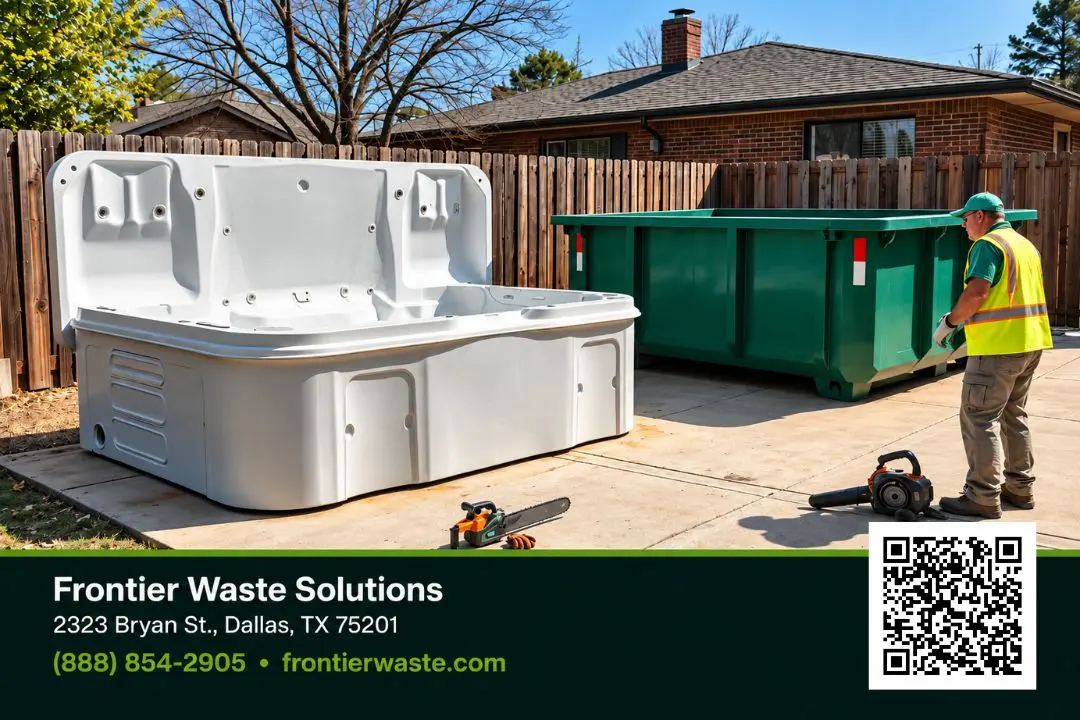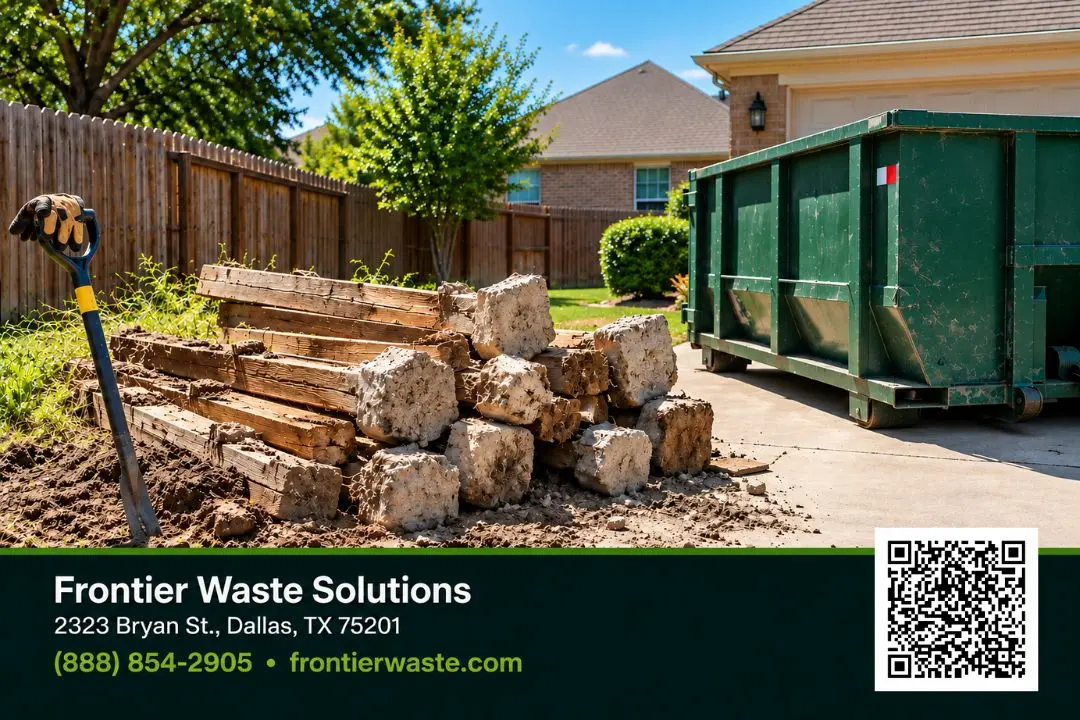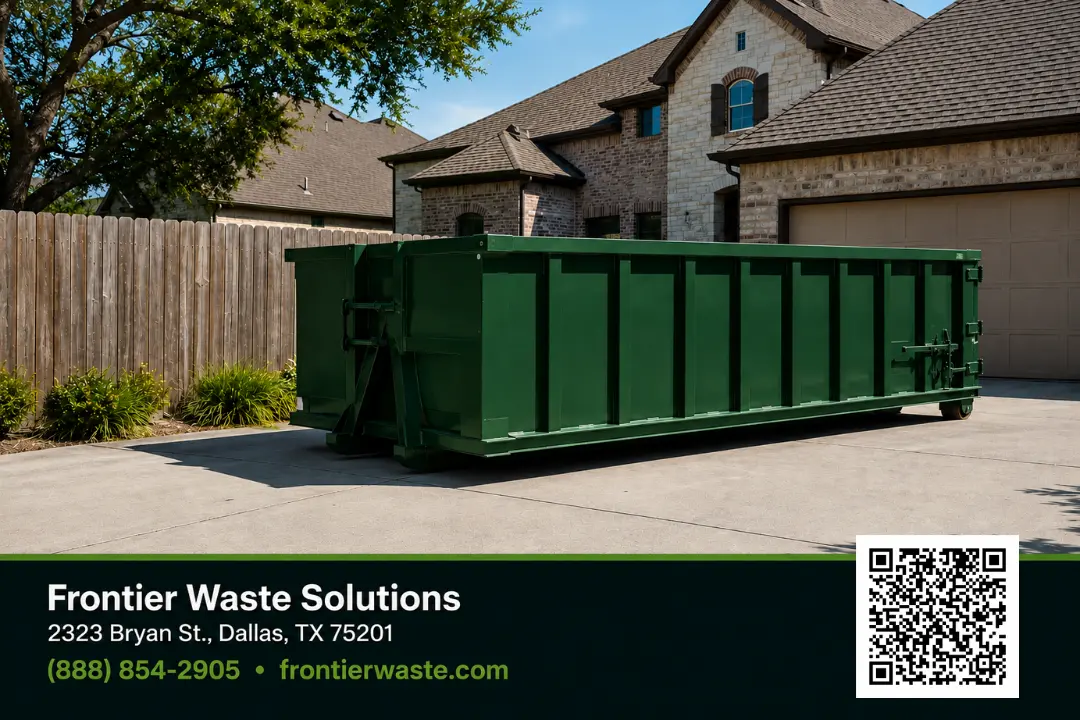
A homeowner in a Frisco subdivision called us last spring already frustrated: the roll-off had been on the driveway two days when a notice showed up on the door, citing a covenant about “temporary structures” nobody remembers reading at closing. The dumpster wasn’t the problem. Nobody had told the HOA it was coming. That’s the part people miss. A roll-off sitting entirely on your own property doesn’t need a city permit in most cases, but your driveway isn’t outside your association’s reach just because it’s yours.
A driveway placement clears one hurdle, not two
City of Dallas permitting is mostly about the public right-of-way: the street, the curb strip, anything outside your property line. Keep the container on your own driveway and you generally sidestep that requirement (city rules vary by exact placement and should be confirmed directly before you rely on this). An HOA’s authority runs on a completely different track. It’s a private contract, the deed-restricted covenants (CC&Rs) you signed when you bought the house, and it can reach anything visible from the street whether it sits on public or private ground. A container that needs zero city paperwork can still be a covenant violation the same week.
That distinction trips people up because it sounds redundant (“I already checked, I don’t need a permit”), when the two approvals were never answering the same question. One governs the street. The other governs how your property looks to the neighbors.
Why the association cares about a box on your driveway
Most covenants weren’t written with roll-offs in mind specifically. They were written to prevent anything that reads as clutter, an eyesore, or a drop in curb appeal: stored boats, commercial vehicles, and yes, a rusting steel container sitting for weeks. A dumpster tied to an active remodel or roof job reads differently to most boards than one that’s been idle for a month, which is usually the actual trigger for a complaint. It’s not that a container showed up, but that it stopped moving.
Where the HOA will make you put it
Nearly every community rule we’ve seen lands in the same place: on your own driveway, never the street, the curb strip, or the lawn. Some go further and ask that it sit toward the garage rather than at the property line, or that it not be visible head-on from the street if a side or rear placement is possible. That second requirement only works if the container actually fits back there, which is worth checking against the published length and width of each roll-off size before you assume a 20-yard will tuck out of sight the way a 15 did for your neighbor.
How long you can leave it before it’s a violation
This is the part we can’t hand you a universal number for, because it isn’t set by the city. It’s set community by community, sometimes board by board. What’s consistent across the guidance we’ve reviewed is the framing: coverage is tied to active work, not a flat number of days, and a container that sits full and idle draws attention faster than one that’s visibly being loaded. If your association’s rules are silent on a specific limit, that’s not permission to leave it indefinitely. It usually means the board decides case by case, which is worse for predictability, not better. Ask your property management company or read the CC&Rs directly rather than assuming a courtesy period exists.
Getting ahead of it: approval, not just a heads-up
Some HOAs only want notice. Others run everything through an architectural review committee that meets on its own calendar and treats a dumpster the same as a fence or a paint color change. If your project is time-sensitive, that meeting schedule matters more than the rental itself. The safest sequence is to find out which kind of association you have before you book, not after the truck is already scheduled.
What most reviews actually want to see is simple: how long, roughly where, and how big. That’s information we can give you as soon as we know the job, and a Dallas dumpster rental scheduled to match your project window gives you a real date range to put in front of the board instead of a vague “sometime this month.”
What actually happens if you skip it
Consequences run from a warning letter to a fine, and in some communities a fine that recurs for every day the violation continues. On a new-construction or remodel project working through an ARC approval process, an unrelated covenant complaint can also slow down the parts of the project that do need board sign-off, which is worth avoiding for reasons that have nothing to do with the dumpster itself. None of this is a reason to skip the container. It’s a reason to spend the five minutes confirming the rule before delivery day instead of after a notice arrives.
The Dallas-area split: this mostly doesn’t apply everywhere
Whether any of this matters at all depends heavily on where in the metro you are. The newer, master-planned subdivisions across Frisco, Prosper, McKinney, and the newer pockets of Plano are almost universally deed-restricted, with an active HOA and an ARC that reviews exterior changes. Drive into the older Dallas neighborhoods (Oak Cliff, the M Streets, Lakewood, most of East Dallas) and a mandatory HOA is the exception rather than the rule. For a homeowner there, the driveway conversation is a city-permit question, not a covenant one. If you’re not sure which category your street falls into, your property tax statement or closing documents usually say so, and it’s worth five minutes to check before assuming either way.
If you manage an HOA’s clubhouse or amenity center
The same question comes up from the other direction. Community amenity centers and clubhouses generate their own steady stream of trash between resident events, and a board or management company doing a renovation there is juggling both a construction container and the property’s everyday service at once. That’s usually two separate accounts running in parallel rather than one: keeping the routine commercial trash pickup for the amenity center on its normal schedule while a temporary roll-off handles the renovation debris, so residents don’t notice a gap in either.
Questions we get about HOA rules and dumpster rentals
Do I need HOA approval for a dumpster that’s only staying a few days?
Sometimes not, since a short, active-project rental is the least likely thing to draw a complaint. But “probably fine” and “confirmed fine” are different, and a quick email to the management company costs nothing. Skipping that step is the actual risk, not the dumpster.
Can my HOA make me move it off the driveway once it’s delivered?
Yes, if the placement conflicts with a rule you agreed to when you bought the property. That’s a stronger argument for checking beforehand than for arguing after delivery, because moving a loaded container is a service call, not a five-minute job.
If it’s staying on my driveway, do I still need a city permit?
Usually not, but “usually” isn’t “always.” Placement, size, and how close you sit to the street can all change the answer. Confirm with the city directly for your specific address before assuming.
What if my community’s rules don’t mention dumpsters at all?
Silence isn’t a green light. It typically means the board evaluates it under a general “no unsightly conditions” clause, which is harder to predict than a written rule, so ask rather than guess.
Does covering or tarping the container satisfy a visibility requirement?
Sometimes it helps, and sometimes the rule is about the container’s presence, not just how it looks. Ask what your specific association wants before assuming a tarp solves it.
Booking around your HOA’s timeline
Once you know your dates, you can book a roll-off dumpster rental for the job, and we’ll build the delivery and pickup around whatever window you’ve cleared with the board, including a straight swap if the approval comes through later than the work does. Extending past that window is simpler to avoid than to fix after the fact, and what extra days actually add to a dumpster rental is worth knowing up front if your approval timeline is still moving.
Frontier Waste Solutions
2323 Bryan St, Dallas, TX 75201
(888) 854-2905