You finally had that storm-damaged elm or overgrown oak taken down — and now there’s a stump sitting in the corner of your Dallas lot. Almost every business owner reaches the same question around the same time: what size commercial dumpster does a business actually need? Order one too small and you’re chasing overflow by Thursday. Order one too big and you’re paying every month for a bin that never fills.
What we can do is walk through what each size actually holds, what it costs, and which one fits your operation — that’s the same conversation we have with most Dallas business owners who call us. If you’re setting up service for a restaurant or bar, our guide to bar and restaurant dumpster service covers the specific pickup patterns those operations need. And if you’re not sure whether a front-load container is even the right tool versus a temporary roll-off, our overview of roll-off dumpster rentals lays out when each one makes sense.
Before you dig in — related reading
- Our commercial trash pickup service page covers all container types and schedules.
- Smaller operations: see right-sized dumpsters for small businesses.
- Looking for Dallas-specific service details? See Dallas commercial trash pickup services.
What Are the Standard Commercial Dumpster Sizes?
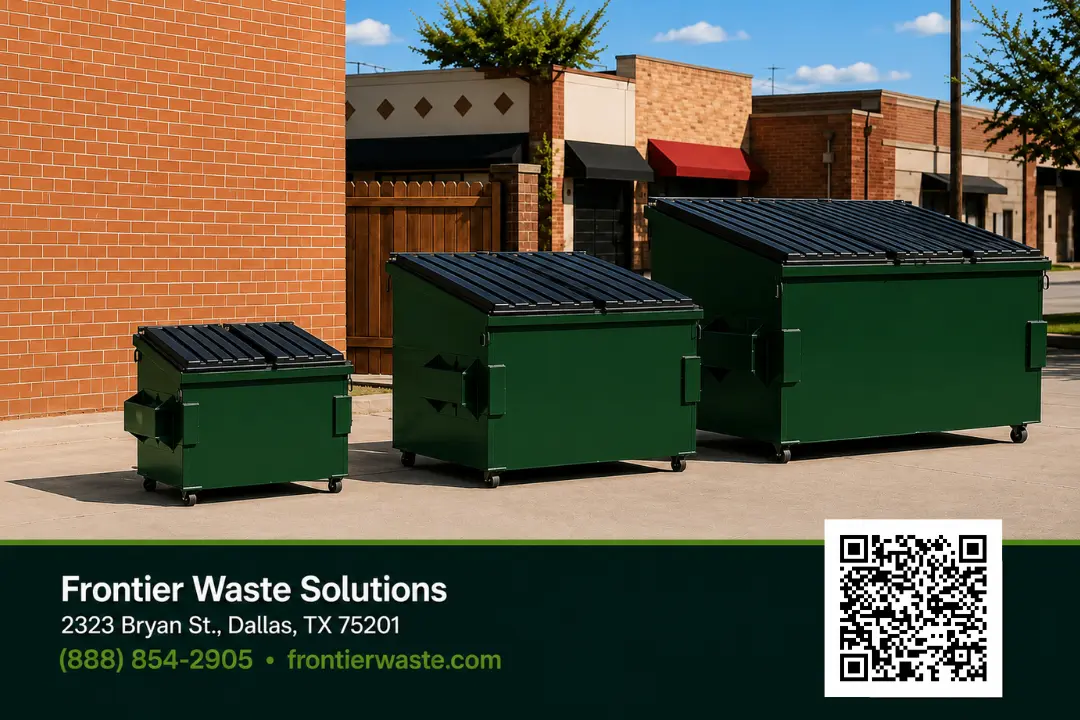
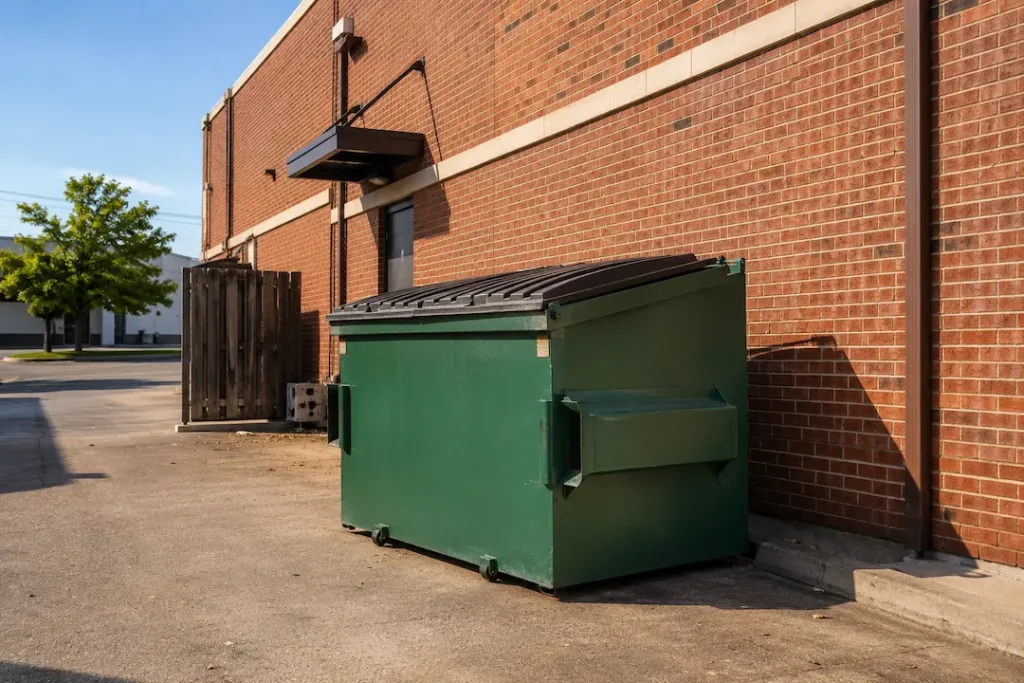
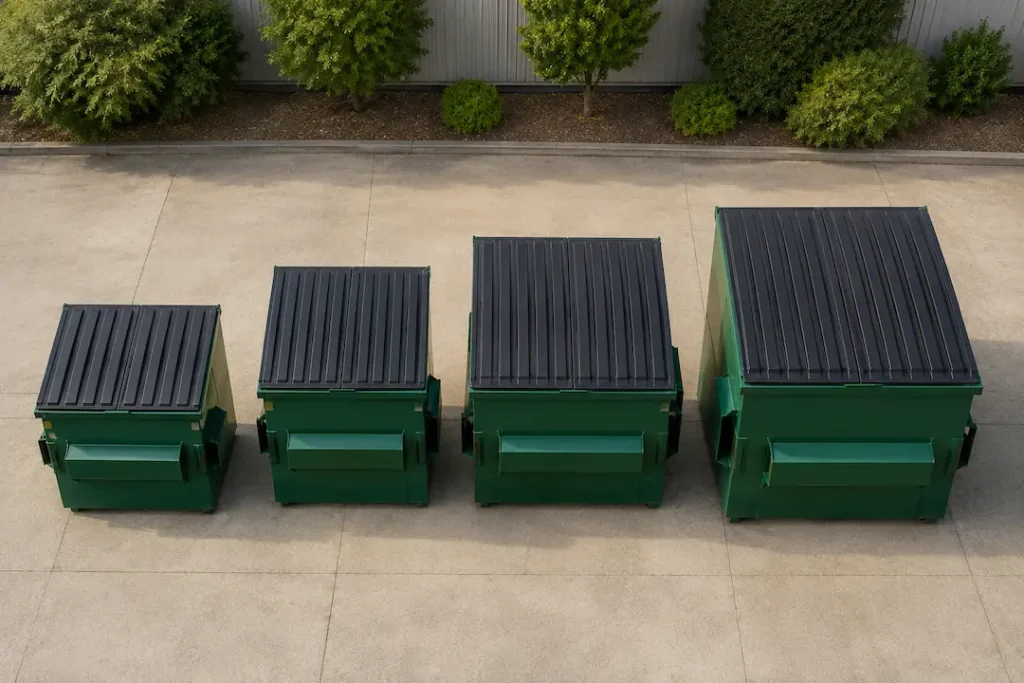
Most commercial waste in Dallas is handled by front-load dumpsters — the metal containers with the slanted lids that a truck lifts over the cab. All sizes share the same 72-inch width; what changes is the depth and height as capacity increases. Here’s what each one looks like on the ground:
| Size | Dimensions (W × D × H) | Best For | Max Pickups/Wk |
|---|---|---|---|
| 2-yard | 72″ × 35″ × 41″ | Small restaurants, offices up to 25 employees | 6× |
| 3-yard | 72″ × 41″ × 50″ | Light retail, salons, businesses up to 50 employees | 6× |
| 4-yard | 72″ × 57″ × 51″ | Mid-size restaurants, offices up to 100 employees | 6× |
| 6-yard | 72″ × 65″ × 64″ | Mid-to-large businesses up to 250 employees | 6× |
| 8-yard | 72″ × 75″ × 72″ | Large businesses up to 500 employees | 6× |
Exact dimensions vary slightly by container and hauler, so treat these as planning figures. If you produce large volumes of bulky or one-time debris — renovation waste, a move-out cleanout — a temporary roll-off is usually the better tool than an ongoing front-load. You can see the full container spec sheet on our commercial trash pickup service page.
What Size Dumpster Does a Restaurant or Bar Need?
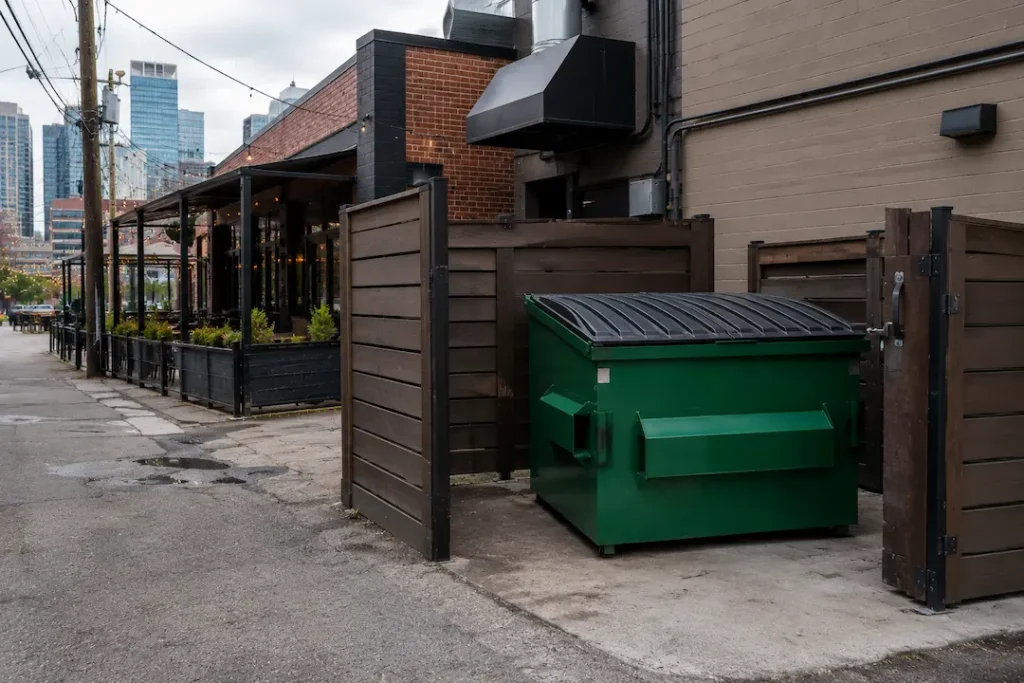
Restaurants and bars are among the heaviest waste producers per square foot, because of food scraps, packaging, glass, and to-go containers. A small cafe or coffee shop can often run on a 4-yard dumpster, while a full-service restaurant or a bar in a busy district like Deep Ellum, Uptown, or Lower Greenville typically needs a 6- or 8-yard container — sometimes paired with more frequent pickups on weekends.
Food waste is dense and wet, so a restaurant bin fills by weight and odor faster than a dry-goods retailer’s does. In the Texas heat that often means restaurants benefit from twice-weekly or more collection regardless of size, plus a separate plan for grease and cardboard recycling. Our guide to bar and restaurant dumpster service covers pickup frequency, grease options, and how to right-size for a seasonal patio operation.
What Size Dumpster Does a Small Business or Office Need?
A small office, salon, boutique, or professional suite usually generates mostly paper, packaging, and light general trash. For these operations, a 2-yard dumpster collected once or twice a week is often plenty — and it slips into a compact enclosure or shared pad without dominating the lot. Growing offices, medical suites, or shops with steady foot traffic tend to move up to a 4-yard.
The honest test is simple: if your current bin is regularly overflowing before pickup day, you either need the next size up or an extra collection — not bags stacked on the ground, which can draw pests and run afoul of property rules. See our breakdown of right-sized dumpsters for small businesses for a closer look at how different retail and office types typically land.
What Size Dumpster Does an Apartment Complex Need?
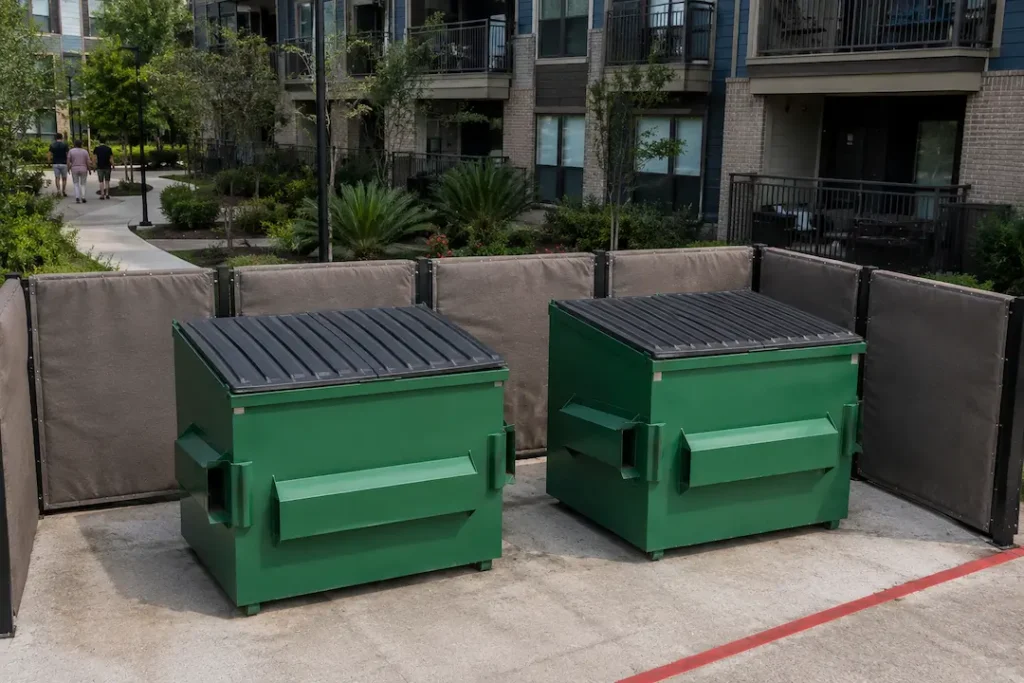
Apartment communities are sized by unit count and resident behavior more than by square footage. Smaller complexes may share a few 6-yard dumpsters, while larger communities in dense Dallas corridors like Uptown, Oak Lawn, or the Design and Medical Districts typically run multiple 8-yard containers with frequent pickups — often supplemented by a compactor at very large properties.
The goal is enough capacity that bins never overflow into the parking area between collections, since overflowing apartment dumpsters are one of the most common resident complaints and code concerns. Many properties also add dedicated recycling and bulk-item plans so move-out furniture doesn’t clog the regular containers. For Dallas-specific service details and how we structure apartment accounts across the city, see our Dallas commercial trash pickup services page.
How Many Trash Bags or Gallons Does a Commercial Dumpster Hold?
One cubic yard holds roughly 200 gallons, so the math works out like this:
Keep in mind that volume is only half the story: every dumpster also has a practical weight limit. Heavy, wet, or dense waste — restaurant food scraps, broken tile, construction material — can hit the weight ceiling well before the bin looks full. If your waste is consistently heavy, a slightly larger container or more frequent service keeps you from straining both the dumpster and the truck.
What Happens If My Dumpster Is Too Small or Too Big?
Too small, and you get overflow: bags on the ground, lids that won’t close, pest problems, and sometimes overage situations when crews have to handle more than the container holds. Too big, and you pay every month for capacity you never use. The fix is rarely dramatic — it’s usually a small adjustment to size or pickup frequency.
A good rule for Dallas businesses is to right-size with a little headroom and revisit it after a season, because waste volume shifts with patio season, holiday retail, and growth. If you’re unsure, it’s better to start slightly larger or add a pickup than to chase overflow every week. And if what you’re really dealing with is a renovation, move-out, or one-time debris load rather than ongoing weekly waste, a roll-off dumpster rental is the right tool — front-load containers are designed for recurring service, not one-time volume.
Where it sits matters as much as how big it is
Sizing in Dallas isn’t only about volume — it’s about footprint. A larger roll-off needs clear, legal space to land, and if the only spot is a public street or alley, the City of Dallas requires a right-of-way permit before delivery. On your own lot or loading area, that’s a non-issue. Confirm the staging spot before you size up, so the container you order actually fits where it’s allowed to go.
Sizing questions, answered
What is the most common commercial dumpster size?
The 4-yard front-load dumpster is the most popular all-purpose choice for Dallas businesses because it balances capacity and footprint for offices, retailers, and mid-size restaurants — and it fits comfortably in most enclosures and alleys without the access constraints of a larger bin.
Is it better to get a bigger dumpster or more frequent pickups?
It depends on your space and waste type. If you have room and generate steady heavy waste, sizing up can be more efficient. If space is tight — a narrow Bishop Arts alley, a shared loading dock — more frequent collection of a smaller bin often works better and keeps costs predictable. We can compare both options once we know your volume and layout.
Do I need a permit or enclosure for a commercial dumpster in Dallas?
Many Dallas commercial properties require screened enclosures, and placement rules can vary by property and location. We confirm the specific requirements for your address before setup rather than assuming — verify any local or property rules that apply to your site before scheduling a delivery.
Can I change my dumpster size later?
Yes. If your bin is overflowing or sitting half-empty, the size or pickup schedule can usually be adjusted. Reach out and we’ll look at your current volume and recommend the better fit — there’s no reason to keep paying for a mismatch.
What if I have a one-time cleanout instead of weekly trash?
For renovations, move-outs, or large one-time debris loads, a temporary roll-off dumpster rental is the right tool rather than an ongoing front-load container. Roll-offs are sized for volume and delivered for a set window — you fill it, we haul it.
Not Sure Which Size Fits Your Dallas Business? Let’s Figure It Out.
Whether you run a Bishop Arts boutique that needs a compact 2-yard on a shared pad, or a Deep Ellum restaurant putting out heavy food waste six nights a week, our commercial dumpster service covers the full range of front-load sizes and pickup frequencies across Dallas and the rest of Texas.
Tell us your business type, how many days a week you operate, and whether access is tight — those three things tell us most of what we need to give you a real recommendation, not just a ballpark.
Frontier Waste Solutions
2323 Bryan St, Dallas, TX 75201
Phone: (888) 854-2905