If you run a shop on Lower Greenville, an office in the Arts District, or a warehouse out near Stemmons, you generate “commercial waste” every single day — even if you’ve never called it that. It’s an everyday phrase in our line of work, but it trips up a lot of owners used to thinking about trash the way they do at home — a cart at the curb, picked up once a week. Commercial waste is a different category, with different rules about who handles it and how. This guide breaks down what commercial waste is, what it includes, how it differs from household and industrial waste, and what it means for a business operating in Dallas.
Before you dig in — related reading
If you already know the basics and just want to handle your business’s trash, these pages get you straight to the details:
- For ongoing service, see our guide to recurring commercial waste collection for Dallas businesses.
- Got a one-time cleanout or build-out? Look at our roll-off dumpster rentals for large one-time waste loads.
- See everything we handle locally on our trash and waste collection services across the Dallas area page.
- Not sure which container fits your waste? See what size front-load commercial dumpster your business needs.
- Smaller operation? Here’s our compact dumpster service for small shops and offices.
- Running a kitchen or taproom? See our dumpster service for restaurants and food-service businesses.
What Is Commercial Waste, Exactly?
Commercial waste is solid waste generated by stores, offices, restaurants, warehouses, and other non-manufacturing business activity. Put simply, if a business or commercial operation created it, it’s commercial waste — regardless of whether the individual items look just like what you’d throw away at home. A coffee cup tossed in your kitchen is residential waste; the same cup tossed in the bin at a café is commercial waste. What changes is the source and the responsibility that comes with it. Businesses typically produce waste in larger, more predictable volumes than a household, and that steady stream is what shapes the kind of container and pickup schedule a business needs.
What Are Some Examples of Commercial Waste?
Commercial waste looks different depending on the business, but the common threads are easy to spot once you know what to look for. A few typical examples:
- Paper and cardboard — office paper, shipping boxes, and product packaging, often the single largest stream for offices and retailers.
- Food waste — kitchen scraps, prep trimmings, and spoiled product from restaurants, cafés, and break rooms.
- Plastics, glass, and metal — bottles, cans, jars, containers, and shrink wrap from day-to-day operations.
- Packaging and shipping material — pallets, foam, and plastic film that come in with inventory and go straight into the bin.
- General trash — break-room waste, floor sweepings, and non-recyclable packaging that doesn’t fit another stream.
- Occasional bulky items — broken fixtures, old furniture, and display materials cleared out during a refresh or move.
The mix matters because it drives whether you simply need general trash collection, recycling alongside it, or special handling for certain materials.
What’s the Difference Between Commercial and Residential (Household) Waste?
The distinction comes down to source, volume, and who’s responsible. Residential waste comes from homes and is usually collected through a standardized municipal program — a roll cart at the curb, emptied on a set day, billed at a flat rate. Commercial waste comes from businesses, tends to be produced in much larger and more variable quantities, and is generally collected with a dumpster on a schedule the business chooses. Just as important, the responsibility shifts: a city often handles residential collection as a public service, but a business typically has to arrange and pay for its own commercial waste service. The materials can overlap — both produce paper, food, and packaging — but the system around them is built differently.
What’s the Difference Between Commercial and Industrial Waste?
These two get lumped together, but they aren’t the same. Commercial waste comes from non-manufacturing business activity — the offices, shops, restaurants, and warehouses described above. Industrial waste comes from manufacturing and heavy processing: factories, plants, and production lines that generate byproducts, scrap, and sometimes regulated process waste tied to how the product is made. A print shop’s discarded paper and packaging is commercial waste; a manufacturing plant’s chemical process residue is industrial waste. The line can blur at facilities that do both, but the category usually follows the activity that produced the waste.
What Are the Main Types of Commercial Waste?
Most of what a Dallas business throws away falls into a handful of streams. Sorting your waste by these types is the first step to choosing the right service and, often, to cutting your costs:
- General solid waste — everyday landfill-bound trash that isn’t recyclable or specially handled.
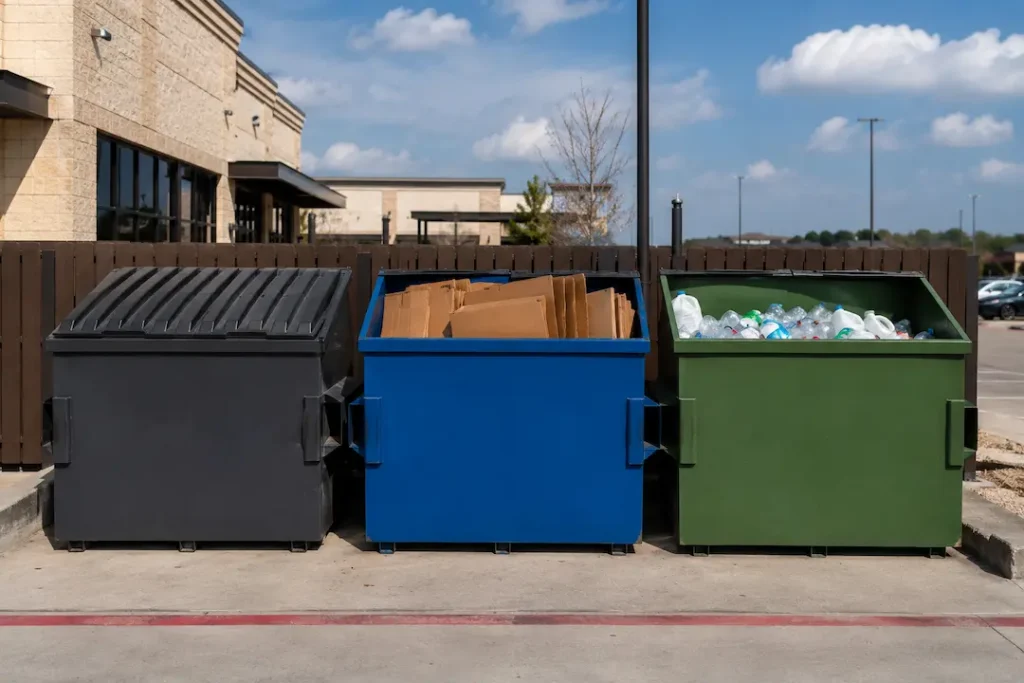
- Recycling — cardboard and paper, plastics, glass, and metal, often collected in a separate container.
- Organic and food waste — heavy, fast-accumulating material from kitchens and food-service areas.
- Bulky and one-time waste — furniture, fixtures, and remodel or build-out debris a regular container can’t absorb.
- Special or regulated materials — electronics, cooking grease, and other items that need separate handling rather than the general trash stream.
Knowing your mix helps you keep recyclables out of the trash stream and flag anything that needs special handling before it becomes a problem.
Who Is Responsible for Handling a Business’s Commercial Waste in Dallas?
This is where commercial waste most surprises new business owners. The City of Dallas Sanitation Services department offers commercial collection built around residential-size garbage and recycling roll carts — it does not provide dumpster or roll-off container service to businesses. In practice, that means once your business produces more than a few carts’ worth of waste (which most do), responsibility for arranging and paying for collection falls to you, through a private hauler. The practical takeaway: don’t assume a city dumpster will appear at your back door. Commercial waste service is something a Dallas business lines up on its own.
How Is Commercial Waste Collected?
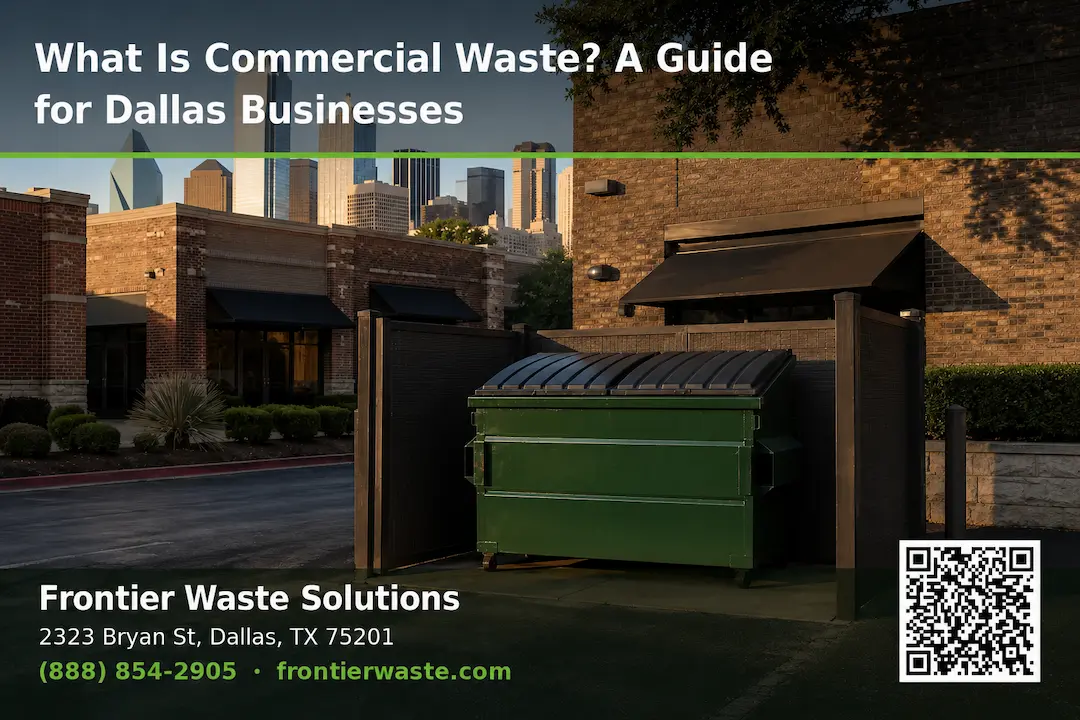
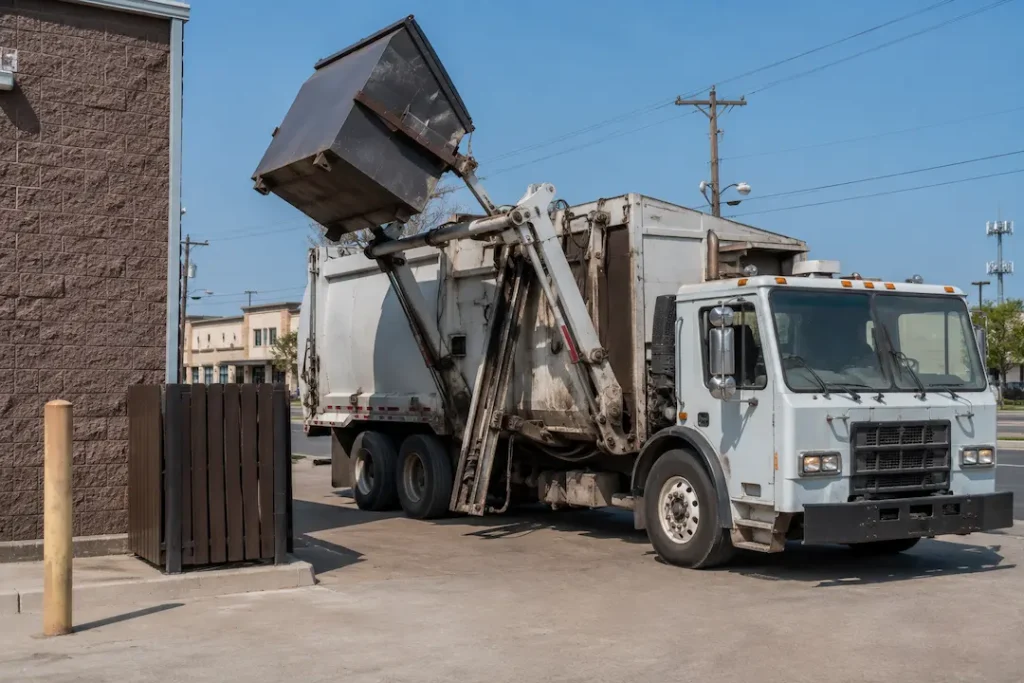
For steady, everyday business waste, the standard tool is a front-load dumpster — the enclosed container you’ve seen behind shopping centers and restaurants — emptied on a recurring schedule that matches your volume, from once a week up to several times a week or daily for high-output kitchens. For one-time bursts of heavy or bulky waste, like a remodel, a tenant build-out, or a big cleanout, a roll-off container is the better fit. Many businesses use both: a front-load dumpster for daily operations and a roll-off when a project temporarily produces more than the regular service can handle.
Who’s actually allowed to haul it in Dallas
There’s a Dallas-specific wrinkle worth knowing: the city’s Sanitation Department doesn’t provide dumpster or roll-off service to businesses, and any private hauler operating in the city must hold a solid waste collection franchise granted by the City Council. In practice, nearly every Dallas business handles commercial waste through a franchised private hauler — and confirming a provider is properly franchised is a quick, sensible step when you weigh your options.
Commercial waste questions Dallas businesses ask
Is commercial waste the same as municipal solid waste?
Not exactly. Municipal solid waste (MSW) is a broad umbrella that includes residential, commercial, and institutional trash collected in a community. Commercial waste is the business-generated slice of that picture. So commercial waste is part of MSW, but MSW also includes the household trash that commercial waste is defined against.
Is cardboard considered commercial waste?
Yes — cardboard generated by a business is commercial waste, and it’s usually one of the largest streams for retailers, offices, and restaurants. Because it’s also highly recyclable, many businesses set up dedicated cardboard recycling to keep it out of the trash and make better use of their containers.
Is restaurant food waste commercial waste?
It is. Food scraps, prep waste, and spoiled product from a restaurant or food-service business are commercial waste. Because food waste is heavy, can create odor, and builds up quickly, kitchens often need more frequent pickups or a larger container than their square footage alone would suggest.
Does my Dallas business have to have commercial trash service?
Most businesses need a reliable way to dispose of their waste, and many leases and local requirements assume one is in place. Specific obligations can depend on your property type and location, so it’s worth confirming what applies to you before assuming a blanket rule.
Who regulates commercial waste in Texas?
Solid waste in Texas is broadly overseen at the state level by the Texas Commission on Environmental Quality (TCEQ), along with local rules that can apply to collection and placement. For day-to-day purposes, what matters most to a business is sorting its waste correctly and working with a licensed hauler.
Sort It Out With Frontier Waste Solutions
Now that you know what counts as commercial waste, the next step is matching it to the right container and schedule. Tell us what your business throws away and roughly how much, and we’ll help you set up commercial waste collection that fits — without overpaying for service you don’t need.
Frontier Waste Solutions
2323 Bryan St, Dallas, TX 75201
Phone: (888) 854-2905